
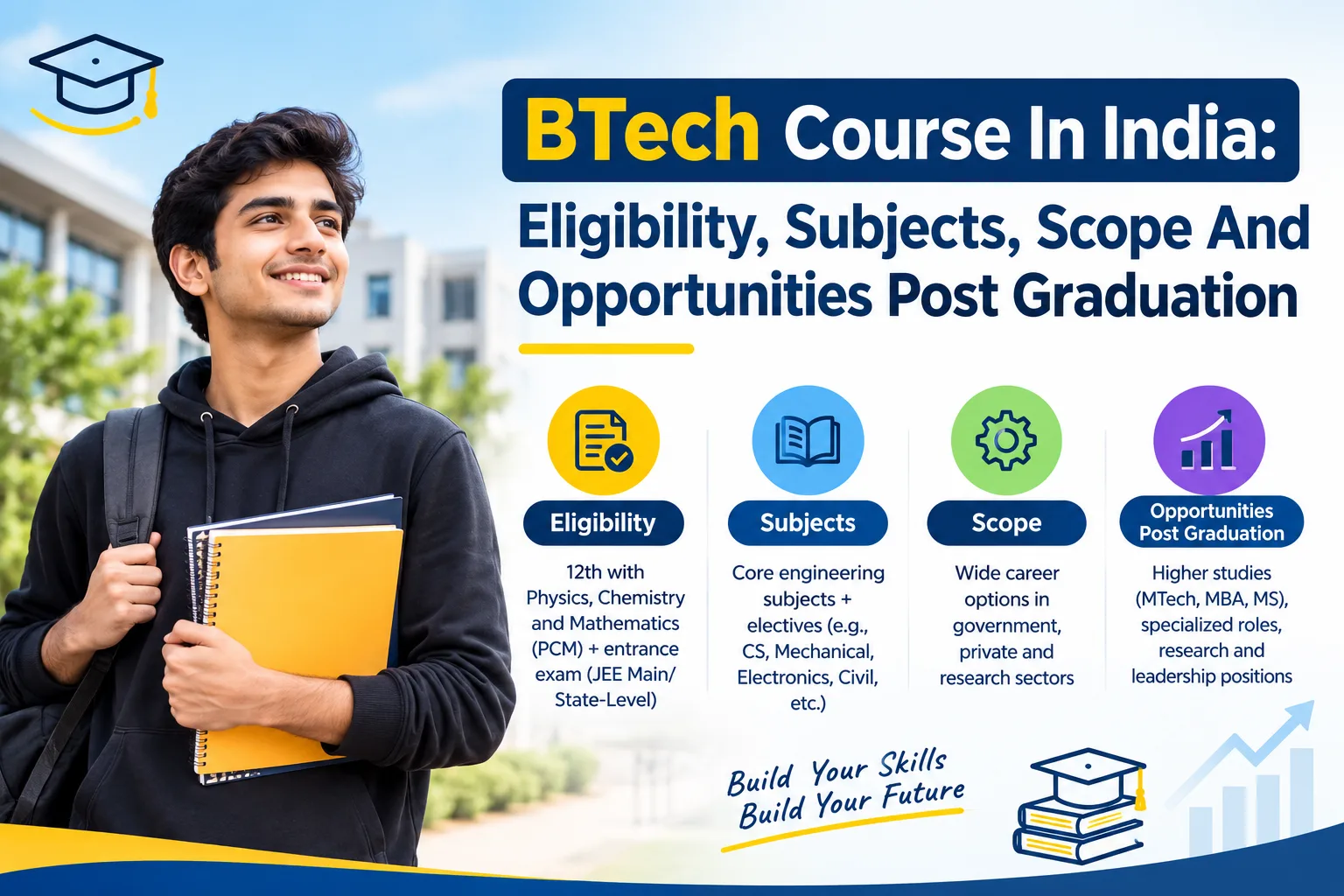
Ask any 12th science student about the career advice their parents, friends and relatives push their way to hear, and you will see engineering at the highest spot. While engineering is a popular choice in India, there are many other subjects too. However, none have been quite as successful in being as old-fashioned as engineering, and for no reason. As you gear up for your BTech admission, if you still get stumped whenever you wonder what all the buzz is around this course, this guide is here to help you take a clearer view.
What Is A BTech course?
Bachelor of Technology is a four-year degree in engineering approved in India and other countries. You start with some foundational science courses to build strong knowledge of fundamentals before delving into specialization topics that can fetch a good job after completing your degree. The four-year degree is essential because a three-year degree would not allow someone to cover the fundamentals and requisite concepts adequately.
BTech Eligibility Requirements
While most colleges demand the completion of Class XII from a science stream with Chemistry, Physics and Mathematics as your principal subjects, several universities allow you to have Computer Science or Biology also if you’re applying for a relevant branch. A score of close to 50% is generally required overall, with some relaxation for SC/ST candidates in several universities to approximately 45%, with individual university variation. If you're a diploma holder, you're not left out either. Many colleges offer lateral entry, letting you join directly in the second year based on your diploma performance.
Entrance Exams: JEE, State Exams & More
JEE Main remains the most widely accepted option across the country, and its scores are used by numerous institutions for admission. Several states also conduct their own entrance tests for local colleges. Competition for certain branches can be intense too, with cutoffs for BTech in CSE seats often sitting higher than other specialisations at many institutes.
In addition to these considerations, many institutions organize their own entrance examinations, while others allow applicants to gain direct entry based solely on their scores in their 12th grade. Thus, applicants have alternative ways to gain access to the engineering field, depending on their scores, the institution they wish to attend, and the time left for them to begin their studies.
Top BTech Specialisations
BTech isn’t a broad degree with a single study path. You have plenty of options to choose from-including traditional main streams like mechanical, electrical and civil engineering, to new-age technology options like BTech AI and data science, Cloud Computing and Biotechnology-to make sure you don’t go with what others prefer but pick what your heart desires. Furthermore, many campuses offer electives now in cybersecurity, robotics, IoT, and other innovative fields, allowing you to personalize the study path you take up, regardless of the major you pick. Spend time understanding the nature of the subject before finalizing the best BTech specialisation for you, since this will be the main focus during the next four years of your college life.
Curriculum And Subjects
A standard BTech degree program consists of four years divided into eight semesters. In the first year, a general base consisting of basic sciences and engineering fundamentals is built up. This subject structure for the initial year is the same regardless of which stream you ultimately choose. This basically levels out the playing field between students in all streams to a considerable extent. It ensures that no one gets left behind even if their branch choice of specialization remains ambiguous at the outset.
Post the first year, subjects delve into specifics pertaining to the chosen branch. General topics from the first-year course are largely phased out, giving way to in-depth specific core papers for the said stream. Apart from theoretical lectures, considerable emphasis is given to laboratory work, mini-projects and workshops where students learn concepts by practically implementing them. By the last year, you’re usually required to have a major project or internship under your name.
BTech Career prospects
Even today, demand for engineers across IT, infrastructure, manufacturing, and power sectors, among others, doesn’t diminish. If you like to study more after doing a degree, you can enroll for a master’s to specialise or enter a managerial career like an MBA later on. Successful graduates usually look for opportunities in the state-affiliated public sector, aiming to clear a government-conducted entrance exam like the GATE to secure jobs in public sector undertakings.
Not everyone joins a corporate giant or public-sector entity directly after a BTech. In fact, many graduates often find the academic grounding to begin their own business endeavours further down the road.
Also Read: What is the scope of (Btech AI) B Tech Artificial Intelligence and Data Science?
BTech Job Opportunities After Graduations
Depending on your specialization in BTech, you may fall under a plethora of entry-level jobs, which can vary from core jobs to software jobs to research roles. Colleges generally recruit through IT companies, manufacturing companies, construction players and consulting houses. This mix depends on a student's college and specialisation, so career outcomes are not the same for everyone.
The key is internship, add-on certification in the concerned field or industry and practical experience, rather than a specific branch you are enrolled in. People opt for AI, ML and such emerging subjects and pursue admissions at various BTech AI colleges due to increased opportunities available these days.
How to select the right BTech course?
Before concluding, be honest about how your branch fits with your actual interest, not just trending keywords. Check the curriculum in depth and analyse the labs and industry connections of the college that seem promising in your list. Whether it is a core branch or BTech in CSE, a long-term vision should be kept in mind, not current trends.
Conclusion
It isn't necessarily a case of choosing the "correct" answer when it comes to a BTech course, as opposed to choosing one that fits your eligibility, inclinations, and long-term objectives in a straightforward manner. Programs in these fields may be pursued at institutions such as Invertis University before one is locked into one specific one. Nonetheless, whatever path you select, do not see this selection as a final destination but merely the beginning of a learning path over these next four years.
Also Read: How to Find the Best University in Uttar Pradesh
Frequently Asked Questions
It is essential to have a Class 12 degree in physics, chemistry, as well as mathematics. A minimum of 50% aggregate marks is required, while a mere 45% is enough for students belonging to the SC/ST category.
The BTech in Computer Science Engineering comprises programming as well as software development. It combines theory with contemporary project work.
Verify the curriculum structure for its depth, laboratory facilities, qualification of faculty and industry-academic link of the college.
Yes. With increasing demand for analysts and automation across various domains, opportunities for talented graduates from CSE remain strong in the long run.
For admissions, you can avail the scores through either JEE Main, CUET test, or the university’s entrance examination.


